Friday, November 10, 2006

Muddy day in Houston


Main Street, looking south from Franklin Avenue, circa 1907

(Sorry for the delay in posting. I've been on vacation this week!)

Labels: , ,

Monday, September 11, 2006

Disaster relief

It didn't take long for Houston to help its neighbor.

Remember when that happened? Just days earlier, a hurricane decimated a major American city on the Gulf Coast. Many were killed or left homeless.

In response, Houstonians organized relief agencies, rounded up supplies and collected donations.
You remember that, right?

Probably not.

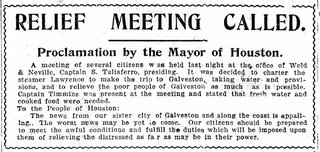
It was 1900. On Sept. 10, local residents gathered at City Council chambers for a meeting to coordinate supplies for Galveston. The meeting, led by Judge Norman Kittrell, resulted in the formation of a citizens' committee to take charge in organizing the relief effort. Benjamin Riesner, a blacksmith, was named chairman of the committee. Mayor Samuel Brashear was also named to the committee.

During the meeting, Texas Gov. Joseph Sayers sent Brashear a telegram saying that he had "taken the liberty of directing that all supplies for food and clothing for Galveston be shipped to you."

Three messages were also read:

  • On Sept. 9, G.N. McElroy, an Arcola station agent for the International and Great Northern Railway, sent word to Brashear seeking assistance. "There are 25 or more people here who are in urgent need of relief, quite a number of whom are sick ladies and children. One lady died before being rescued and a little girl is dying from injuries. The sick and homeless people need to be carried to a place of shelter."
  • Houstonian Rosine Ryan offered to volunteer her time to help with the relief effort.
  • Finally, William Randolph Hearst's New York Journal might have been looking for a scoop. "Can you give the Journal an idea of the extent of the calamity as to loss of life and property, what relief measures in your opinion should be inaugurated?"

President McKinley sent a note to Gov. Sayers inquiring about the number of rations and tents Galveston would need.

In the end, Katrina wasn't the first time Houston mobilized to help a storm-ravaged town.

(The above proclamation was published in the Sept. 10, 1900, edition of the Houston Daily Post.)

Labels: ,

Thursday, September 07, 2006

While Galveston suffered...

Houston also took a serious hit from the 1900 storm.

One of the first reported deaths from the hurricane was that of Henry C. Black, a hired driver for funeral director Sid Westheimer.

A Second Ward alderman was going home at about 1:30 a.m. Sept. 9 when he noticed a body lying in a gutter in front of the Wells Fargo Express Company building. A downed power line was lying across the body.

The body was taken to the Houston Daily Post offices and was quickly identified as Black. Officials said it appeared Black was electrocuted by the downed power line.

"There were burns on the hands and on one of the legs, the flesh was seared to the bone," the Post reported.

Black was taken to his home in the 2200 block of Center Street once the storms subsided.

Other damage reported in Houston:

  • The roof of the Post building was torn off, flooding the presses.
  • The windows at the police station were shattered and the roof of the "prison department" was blown off.
  • A house at Tuam and Fairview caught fire after it was blown off its pillars.
  • The roof of the dining room at the Capitol Hotel was blown off.
  • Windows at the Southern Pacific offices at Franklin and Main Street were blown out.
  • The Grand Central depot and its hotel also lost much of its roof.
  • "The roof of on one wing of the Lawler Hotel was blown off and many of the windows in the building were shattered. The guests became alarmed and the crying of the ladies and children increased the excitement."

Labels: ,

Wednesday, September 06, 2006

Trouble beyond the horizon


This appeared in the Sept. 7, 1900, edition of the Houston Daily Post.

On Sept. 6, Isaac Cline, the Weather Service official in charge at Galveston, wrote that he had seen scattered clouds and northerly winds that day. Nothing too out of the ordinary.

That afternoon, he received a note from Washington, D.C., saying the tropical storm was over southern Florida. He figured it would head out toward the Atlantic.

Life continued on the island. Trouble -- was just beyond the horizon.

Plenty has been written about the Galveston storm of 1900. The information provided above came from Erik Larson's excellent book, "Isaac's Storm."

In the coming days, I'll post how the storm affected Houston and how local residents managed in its aftermath.

Labels:

Sunday, September 03, 2006

Valentine's Day snowfall


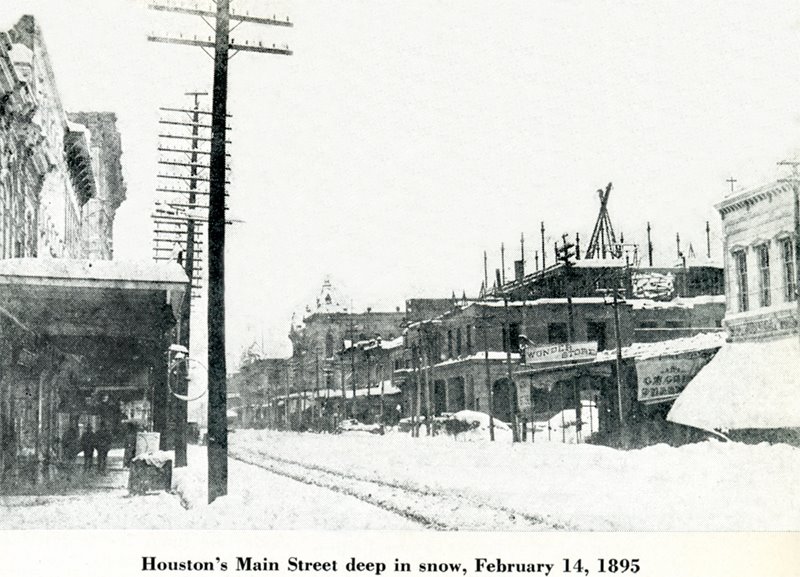
The worst recorded snowfall in Houston's history likely occurred on Feb. 14 -15, 1895. In all, the city received about 20 inches of snow. Measurable amounts of snow would not be recorded again in Houston until 1912.

Today's weather forecast is located here. For better or worse, there's no mention of snow.

Labels: