Tuesday, April 03, 2007

Streetcar shooting

It happened somewhere near Tuam and Albany streets.

On March, 11, 1918, a person the Houston Post described as a "demented negro" reportedly shot two men during an altercation on a streetcar.

The suspect, W.H. Thompson, believed the car's conductor, R.N. Wells, was trying to sprinkle "hoodoo" powder on him.

The trouble started when the man tried to leave the streetcar before it came to a stop. When the conductor objected, the man replied, "You can't work no spells on me."

By this time, the streetcar was at Taft and Fairview, the Post reported.

A few blocks later, near Tuam and Albany, the man fired a gun at Wells, striking him in the shoulder.

Wells jumped from the streetcar. At the same time, an outbound streetcar also came to a stop at the intersection.

George Wilson, an engineer at the Home of the Good Shepherd, was a passenger on the outbound car. When he and all the other passengers learned what was going on, he chased Thompson. During that time, Thompson fired again, striking Wilson in the shoulder.

As a mob of passengers gave chase, Thompson was able to flee into a home on Whitney Street, where he called police and surrendered.

Hearing gunfire, many residents in the area came out armed with weapons as well.

Both Wells and Wilson were taken to St. Joseph's Infirmary and treated for minor injuries.

Thompson, who had been tried about a year earlier for attempting to assault a woman in the 200 block of Hathaway (now Westheimer), was arrested and charged with two counts of assault to murder.

Labels: ,

Sunday, March 25, 2007

1913 Map of Houston

I found this map over at the Texas State Library and Archives (via Houstorian). While you're over at Houstorian, check out the write-up on the history of Shepherd Drive.

Labels: ,

Thursday, March 08, 2007

Galveston Causeway: Target of sabotage?

On July 12, 1917, a watchman saw someone toss a lighted bomb from a northbound M.K. & T. train after it passed over the Galveston Causeway.

The Houston Chronicle reported that the man grabbed it and threw it into Galveston Bay. In doing so, he ended up burning his hand.

Maxwell Arentzen, a Philadelphia native who was enjoying a free ride on the freight train, was held on charges related to the attempted bombing. But he told authorities he was removed from the train before the bomb was to have been thrown. Investigators told the Chronicle his story appeared credible.

In its coverage, the Houston Press reported that had the bombing been successful, it "would suspend a flow of munitions for the allies through" Galveston.

Southern Pacific and federal officials combed the bay with hooks to find the explosive. No bomb was found in the days following the incident.

Labels: , ,

Saturday, January 13, 2007

Last of the Ship Channel pics


I thought I had posted all of them, but here is the last photo from the set of Ship Channel pics that I had.

Labels: ,

Friday, December 15, 2006

The explosion of the Farmer

Two steamers, the Farmer and the Neptune, were racing from Galveston to Houston on March 23, 1853. During the race, the Farmer exploded, killing J.M. Reynolds.

A coroner's inquest into Reynolds' death was held at Galveston, the Houston Democratic Telegraph and Texas Register reported a few days later.

The jury decided that Reynolds died from injuries received when the Farmer exploded during the race.

Blame for the explosion was not placed on the owners or agents of the Farmer. In fact, the paper reported, "Gen E.B. Nichols is the principal, if not the sole, agent in this city of the line to which the Farmer belonged, and he informs us that he repeatedly charged Capt. Webb not to engage in racing with the Neptune or any other boat."

Labels: , ,

Wednesday, December 13, 2006

Turning basin, circa early 1920s

Note bridge at top of photo.

Labels: ,

Wednesday, November 01, 2006

Paulhan postscript

Labels: , ,

Sunday, October 29, 2006

When aviation landed in Houston

The Houston Post touted it as the opportunity to see the “greatest invention of present era.”

In fact, the Post co-sponsored the event, so naturally the newspaper would play up the spectacle.

In the end, Frenchman Louis Paulhan’s flight over South Houston was the first documented flight of a heavier-than-air flying machine in Texas.

By the time Paulhan arrived in Houston, he was an accomplished aviator and record holder. His two-day appearance here in Feb. 1910 was part of a tour that included stops in Los Angeles, Salt Lake City and New Orleans.

Some notes from his appearance in Houston:

*Paulhan flew a Farman biplane.

*Admission, which included a round-trip ride on the Galveston, Houston and Henderson railroad, cost $1.25 (about $26 today). Those arriving by automobile paid less.

*The first flight was delayed a few hours because his plane was not assembled early enough.

“When the mammoth dragonfly-looking machine left the earth, a murmur disturbed the previous silence, and within an instant, the retreating aviator received a welcome from 3,000 throats,” the Post reported in its Feb. 19, 1910 edition.

During that first flight, Paulhan flew south-southeast and circled back over the spectators. Once he landed, a “great many thought the flights for the day over and boarded waiting trains for Houston.”

Actually, Paulhan landed because of engine trouble, according to the Post. Once that was fixed, he flew three more times and stopped when it started to get dark.

Paulhan eventually returned to Europe, setting more aviation firsts. He flew in WWI and became a seaplane builder once the war ended.

Anyone interested in local aviation history should tour the 1940 Air Terminal Museum at Hobby Airport.

A historical marker about Paulhan’s Houston appearance is here.

Labels: , ,

Tuesday, September 26, 2006

Pack your bags!

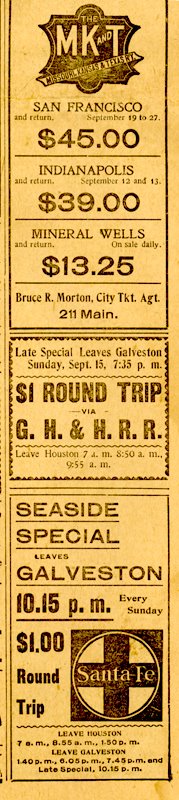
These advertisements were published in the Sept. 14, 1901, edition of the Houston Daily Post.

According to an inflation calculator, what cost $45.00 in 1901 would cost $997.00 these days. A $1 round trip on the Santa Fe to and from Galveston would cost $22.16 in 2005 dollars.

I think I’ll take I-45 instead.

Labels:

Friday, June 23, 2006

Let's back up for a second


Houston's Grand Central Depot, above, was located close to where the Southern Pacific Depot was constructed. The photo is from a postcard mailed in 1910.

Records show that by the end of 1887, an $80,000 Central Depot was completed. It was later renovated in 1906 and in 1914. It is assumed that refers to the train station identified above.

Of course, these train stations were not the only ones to exist in Houston in the early 20th century!

Labels: ,

Monday, June 19, 2006

Houston's Southern Pacific Depot

A Saturday morning breakfast was the only ceremony that marked the opening of Houston's Southern Pacific Depot.

Sometime in September 1934, the descendants of Gen. Sidney Sherman gathered around a breakfast table at the terminal with other newspaper reporters and munched on fried chicken and toast.

No speeches, no ribbon cutting. A woman from San Angelo was the first to purchase a ticket at the new terminal. The trip: Houston to Bay City.

According to the WPA guide to Houston, the total cost of construction came out to $4,347,000 in 1934 dollars ($62,050,368 in 2005 dollars).

The building was located at 329 Franklin Ave., where the downtown post office is today. It was open from 5:30 a.m. to midnight daily.

The building was demolished in 1960. Two items from the old structure were rescued from demolition. The lighted Southern Pacific sign outside the train station was moved to the Southern Pacific building on Travis.

The other item...well, I'll save that for another day.

UPDATE: The Southern Pacific sign lives on at the Houston Railroad museum.

Labels: , ,